
Clogged Downspouts: The Overlooked Half of Gutter Cleaning

Brad Bailey · Co-Owner & Operations Manager
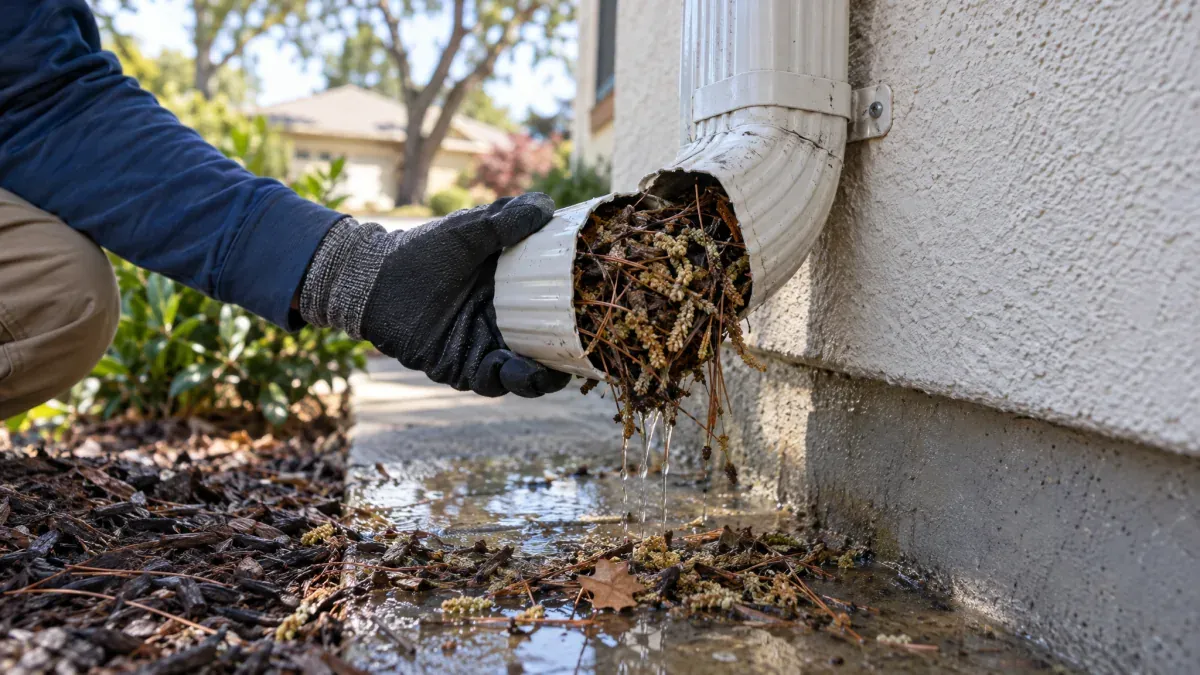
Here’s a scene we run into all the time: a homeowner cleared their gutters themselves, scooped out every leaf, and still got a waterfall over one corner in the next storm. The gutters were spotless. The problem was the part they couldn’t see — the downspout.
Downspouts are the overlooked half of gutter cleaning. A gutter only works if the water it collects has somewhere to go, and a clogged downspout turns a clean gutter into a bathtub. After years of servicing gutters across the Sacramento area, we can tell you that blocked downspouts cause as much overflow as blocked gutters — people just don’t think to check them.
Why a clean gutter still overflows
A gutter is a channel; a downspout is the drain. Clear the channel but leave the drain blocked, and the gutter fills up and spills over the nearest low point. That’s why a spotless-looking gutter can still dump water down your siding.
The clog usually hides at a bend. Downspouts run straight down, then elbow out at the top and again at the bottom, and debris loves to pack into those elbows. On homes with underground drains — the pipe that carries water away from the foundation — the blockage can be even further down, where you’d never see it from a ladder.
The signs of a clogged downspout
- Overflow at one specific corner. If water pours over at the same spot every storm — usually right where a downspout connects — that downspout is likely blocked, even if the gutter looks clear.
- Water pooling at the foundation. If the ground stays soggy at the base of a downspout, or you see a puddle hugging the house where the water should be running off, the downspout or the underground drain isn’t carrying it away.
- A gurgling or glugging sound. Water struggling past a partial blockage makes a distinct gurgle. It’s an early warning that the pipe is restricted before it fully clogs.
- A downspout that sounds hollow or stays dry in rain. Tap it — a packed downspout thuds instead of ringing. And if water’s going into the gutter but not coming out the bottom, it’s stuck somewhere in between.
Why Sacramento downspouts clog so easily
Our trees are the culprit. In spring, oaks drop fine catkins — those stringy little tassels — and they’re the perfect size to wash into a downspout and knit into a dense plug. Come fall, pine needles do the same thing: they’re small and stiff, they slide right past a gutter screen, and they pack into the elbows and pipe like straw. Add the shingle grit that rinses off every roof, and a downspout fills from the bottom up without ever showing a problem at the top.
It’s why the little creatures find these spaces inviting, too — a packed, damp downspout is exactly the kind of sheltered nook that attracts nesting pests, which we get into in professional gutter cleaning and pest prevention. Homes under heavy canopy in neighborhoods like Land Park and East Sacramento deal with the oak catkin problem; foothill-adjacent areas around Folsom get the pine needles. Many homes get both.
Why we flush and test flow — every time
This is where a professional cleaning separates itself from a quick scoop. Clearing the gutter is only half the job. We flush each downspout with water and watch what comes out the bottom. If it runs free and clear, the drain is doing its job. If it backs up, trickles, or gurgles, we know there’s a blockage and we work it loose — from the top, from the bottom, or both — until flow is restored.
Testing flow is the only way to actually know the system works. You can’t confirm a downspout is clear by looking at the gutter above it. If you’re cleaning gutters yourself, running a hose down every downspout and confirming it drains freely at the bottom is the step most people skip — it’s point one in 7 tips while learning how to clean gutters.
Why it’s worth getting right
A blocked downspout doesn’t just cause a nuisance overflow. It dumps concentrated water at one point against your foundation, soaks the soil where you least want it, and sends water down the siding and behind the fascia. The whole reason gutters exist is to move water away from the house — a clogged downspout defeats that, often in the exact spot that does the most damage.
So the next time your gutters are clean and you’re still getting overflow, don’t assume you missed a leaf. Check the downspouts. And if you’d rather have someone flush and test the whole system — gutters and drains — we’re glad to help. Learn more about our professional gutter cleaning service, or get in touch for a free quote and we’ll make sure the water actually makes it to the ground.
Get a Free Estimate
Ready to see what a professional clean can do for your property? Get your no-obligation quote today.
