
How to Remove Black Streaks & Moss From Your Roof (Sacramento's Gloeocapsa Problem)

Brad Bailey · Co-Owner & Operations Manager
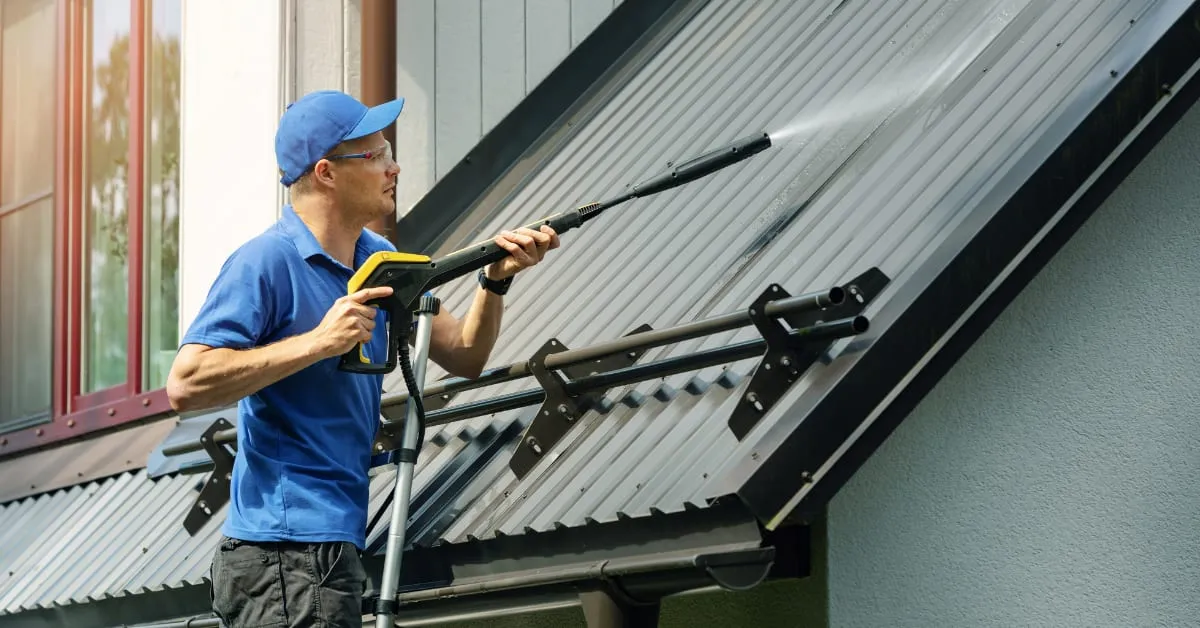
If you’ve looked up at your roof and seen dark streaks running down the shingles — or a carpet of green on the shaded side — you’re not looking at dirt or soot. You’re looking at living organisms that have set up house on your roof and are slowly feeding on it.
After 15+ years cleaning roofs around Sacramento, we can tell you two things for certain. First, almost every roof here gets this eventually — it’s the climate and the tree canopy, not neglect. Second, the reason it keeps coming back for so many homeowners is that they’re treating the symptom instead of killing the cause. Here’s what’s actually growing up there, and how it gets removed for good.
Those black streaks are algae — Gloeocapsa magma
The dark stains that streak down a roof are caused by a blue-green algae called Gloeocapsa magma. It travels by airborne spores, lands on your roof, and feeds on the limestone filler in asphalt shingles. As it grows it forms a dark, protective sheath that creates those unmistakable black streaks running downhill with the water flow.
It’s not just ugly. The algae mat holds moisture against the roof and, over time, contributes to granule loss and premature aging of the shingles — which is exactly what you don’t want from the layer that’s supposed to protect your house.
Moss is the bigger threat — and it loves your north slope
Where algae stains, moss attacks. Moss is a true plant with root-like structures (rhizoids) that anchor into the gaps between shingles and tiles. As it grows and swells with water, it lifts shingle edges and tile, opening paths for water to get underneath. That’s how a cosmetic problem turns into a leak.
Moss is picky about where it settles, and in Sacramento it almost always picks the same spots:
- Shaded north- and east-facing slopes that get the least sun and stay damp the longest.
- Under overhanging trees — the oaks over neighborhoods like Land Park and East Sacramento drop fine debris and throw shade that keeps a roof from ever fully drying out.
- Foothill-adjacent homes where morning fog and higher moisture around Auburn and the El Dorado Hills area feed growth for a longer stretch of the year.
Add our long, damp cool season and you’ve got near-ideal moss conditions on any roof that doesn’t get full sun.
Why rinsing it off never lasts
Here’s the honest part most people learn the hard way. You can climb up, scrape the moss, hit the streaks with a hose or a pressure washer, and the roof will look clean that afternoon. But if the organism is still alive — and after a rinse or a scrape, it is — it grows right back. Often within a single season.
Worse, the two most common DIY fixes each cause their own damage. Pressure washing strips the protective granules off your shingles and can crack tile (we explain why in soft washing vs. pressure washing a roof). And scraping moss by hand tears at the surface and rarely gets the rhizoids anchored down in the seams. You end up with a roof that’s damaged and still infested.
The fix: kill it at the root with a soft wash
Removing roof growth so it actually stays gone comes down to chemistry, not force. A professional soft wash applies a roof-safe cleaning solution at low pressure that kills the algae and moss at the root — the whole organism, not just the visible top layer. Once it’s dead, it releases from the roof and rinses away gently, and because the living colony is gone rather than relocated, the roof stays clean far longer before spores can re-establish.
For heavy moss, the growth often dies in place and then weathers off over the following weeks with rain — pulling it all off wet and green would mean scrubbing the roof, which defeats the purpose. The goal is always to let the treatment do the work so the roof doesn’t have to take any abuse.
Keeping it from coming back
No treatment makes a Sacramento roof immune — spores are in the air and the trees aren’t going anywhere. But you can stretch the time between cleanings a lot by keeping overhanging branches trimmed back, clearing leaf debris off the roof and out of the valleys, and staying on a sensible cleaning rhythm for your shade and tree cover. Our overview of essential roof cleaning services covers what that upkeep looks like, and the full complete guide to professional roof cleaning ties it all together.
The bottom line
Black streaks are Gloeocapsa algae; the green on your shady slopes is moss digging into the roof. Both are alive, both do real damage, and both come back fast if you only rinse the surface. The only fix that lasts is one that kills the growth at the root without harming the roof — and in our climate, that means a soft wash, not a pressure washer.
If your roof is streaked or going green, we’re happy to take a look. Learn more about our professional roof cleaning service, or get in touch for a free quote and we’ll give you a straight assessment for your home.
Get a Free Estimate
Ready to see what a professional clean can do for your property? Get your no-obligation quote today.
