
HOA Roof-Cleaning Requirements in the Sacramento Area

Brad Bailey · Co-Owner & Operations Manager
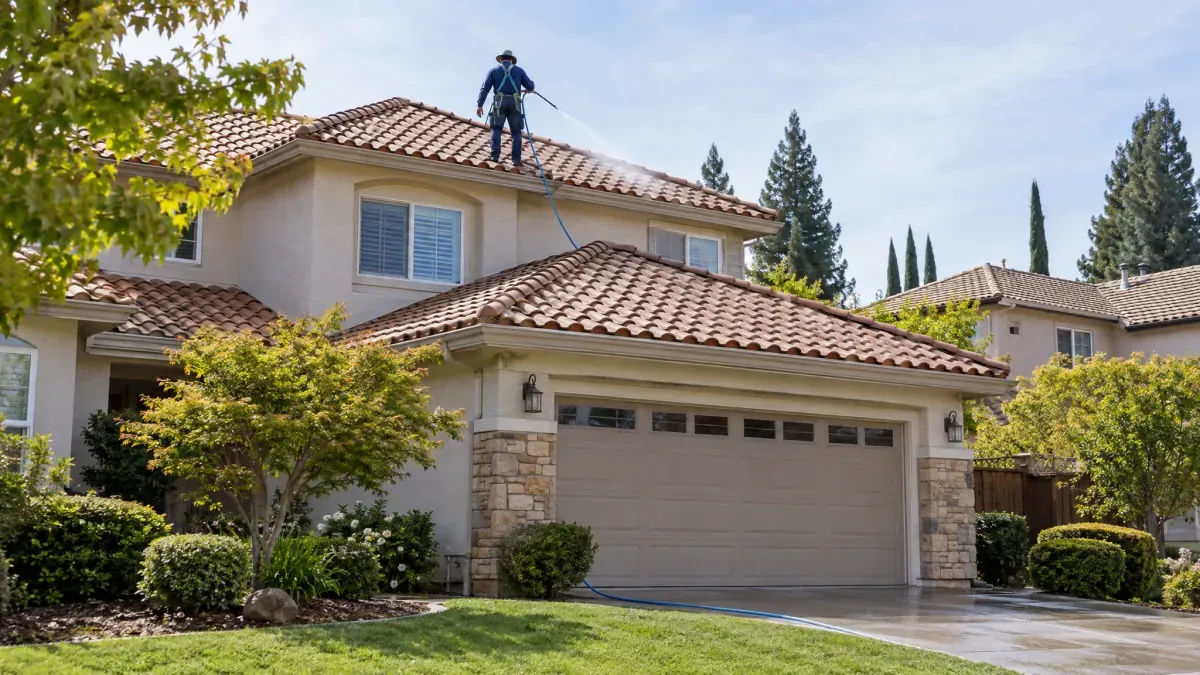
If a letter from your homeowners association showed up pointing at your roof, you’re not alone — and you’re not in trouble as long as you handle it promptly. Across the newer master-planned communities in our area, roof appearance is something HOAs pay close attention to, and a streaked or mossy roof is a common reason a notice goes out.
We’ve helped a lot of Sacramento-area homeowners clear exactly these notices, so here’s an honest, practical rundown: why your HOA cares, what the rules usually require, what a violation notice actually means, and how to get back in good standing quickly without wrecking your roof in the process.
Why your HOA cares about your roof
An HOA’s whole job, in its own eyes, is protecting the look and property values of the neighborhood. Roofs are a big, visible part of that. A home with dark streaks striping the shingles or green moss creeping across the tiles stands out from the street, and in a community where uniform curb appeal is the selling point, that’s the kind of thing boards act on.
It shows up most in the newer subdivisions where homes share a similar roof style and the community standards are strict. Tile-roof neighborhoods around Roseville, Folsom, El Dorado Hills, and Granite Bay tend to have the most active expectations here — and ironically, those same areas get plenty of foothill moisture and shade that feed roof growth in the first place.
What CC&Rs usually say about roofs
The rules live in your community’s CC&Rs (Covenants, Conditions & Restrictions) and sometimes in a separate set of architectural or maintenance standards. Language varies from one association to the next, but the roof provisions usually boil down to a few themes:
- Keep the roof clean and well-maintained — free of visible staining, streaks, and growth.
- No moss, algae, or debris accumulation that’s visible from the street or common areas.
- Maintain the original appearance of the roofing — which is why those black algae streaks and green moss patches tend to trigger attention.
Note what these almost never say: they don’t tell you how to clean the roof. That part is left to you, which matters a lot, because the wrong method can create a bigger problem than the one you’re fixing. If you want to understand what you’re actually looking at up there, our post on removing black streaks and moss explains the growth behind most notices.
The violation notice — and the clock that comes with it
A roof violation usually arrives as a written notice giving you a window of time to “cure” the issue — that is, get the roof cleaned — before the next step. Associations handle escalation differently, but ignoring the letter is the one move that reliably makes things worse; continued non-compliance can lead to follow-up notices, hearings, and fines depending on your community’s rules.
The practical takeaway is simple: don’t sit on it. Most notices are easy to resolve, and a board that sees you’ve acted promptly is a board you won’t hear from again on this.
Why DIY (or a quick pressure wash) can backfire
When the clock is ticking, the temptation is to grab a pressure washer or hire whoever can come blast it off fastest. We’d urge you not to. High pressure strips the protective granules off shingles and can force water under shingles and tiles — and on tile roofs, walking and blasting breaks and shifts tiles. You could end up trading an appearance notice for actual roof damage, which is a far worse letter to get.
There’s a second catch: spraying only knocks the surface growth down. The algae and moss roots stay behind, so the streaks come back — sometimes before the next HOA cycle is even over. Then you’re paying to do it twice.
The method that satisfies the HOA and protects the roof is a low-pressure soft wash: a treatment that kills the growth at the root, followed by a gentle rinse. It leaves the roof genuinely clean, stays clean longer, and is safe for both tile and composition shingle.
How to comply fast — and stay compliant
Here’s the straightforward path we walk homeowners through:
- Read the notice and note the deadline. Know exactly what the association is asking for and by when.
- Get the roof soft-washed by a pro, not pressure-blasted. This both resolves the streaks and avoids causing the damage a board could cite next.
- Keep your documentation. A dated record that the roof was professionally cleaned is useful if the association asks for proof of compliance.
- Get ahead of the next cycle. Because our shaded, damp-prone foothill communities regrow algae and moss, a simple maintenance rhythm keeps you off the HOA’s radar for good. How often depends on your trees and shade — we cover that in how often you should clean your roof.
Wondering what a cleaning runs? The factors that drive it — roof size, pitch, access, tile vs. shingle, and how much growth has built up — are laid out in our roof cleaning cost guide for Sacramento.
We handle HOA-notice turnarounds
Because we work throughout these HOA-heavy communities, clearing a roof violation is routine for us. We’ll get out to look at your roof, soft-wash it to a clean, streak-free finish that meets community standards, and leave you with what you need to show the board it’s handled — without the pressure-washing damage that creates a new problem down the line.
The bottom line
An HOA roof notice isn’t something to panic over, but it is something to act on. The rules in most Sacramento-area communities come down to the same thing — a clean, streak-free, moss-free roof — and the fastest way to satisfy that while protecting your biggest investment is a professional soft wash, not a rushed pressure blast.
Got a notice with a deadline on it? Learn more about our professional roof cleaning service, or get in touch for a free quote and we’ll help you clear it quickly and the right way.
Get a Free Estimate
Ready to see what a professional clean can do for your property? Get your no-obligation quote today.
